
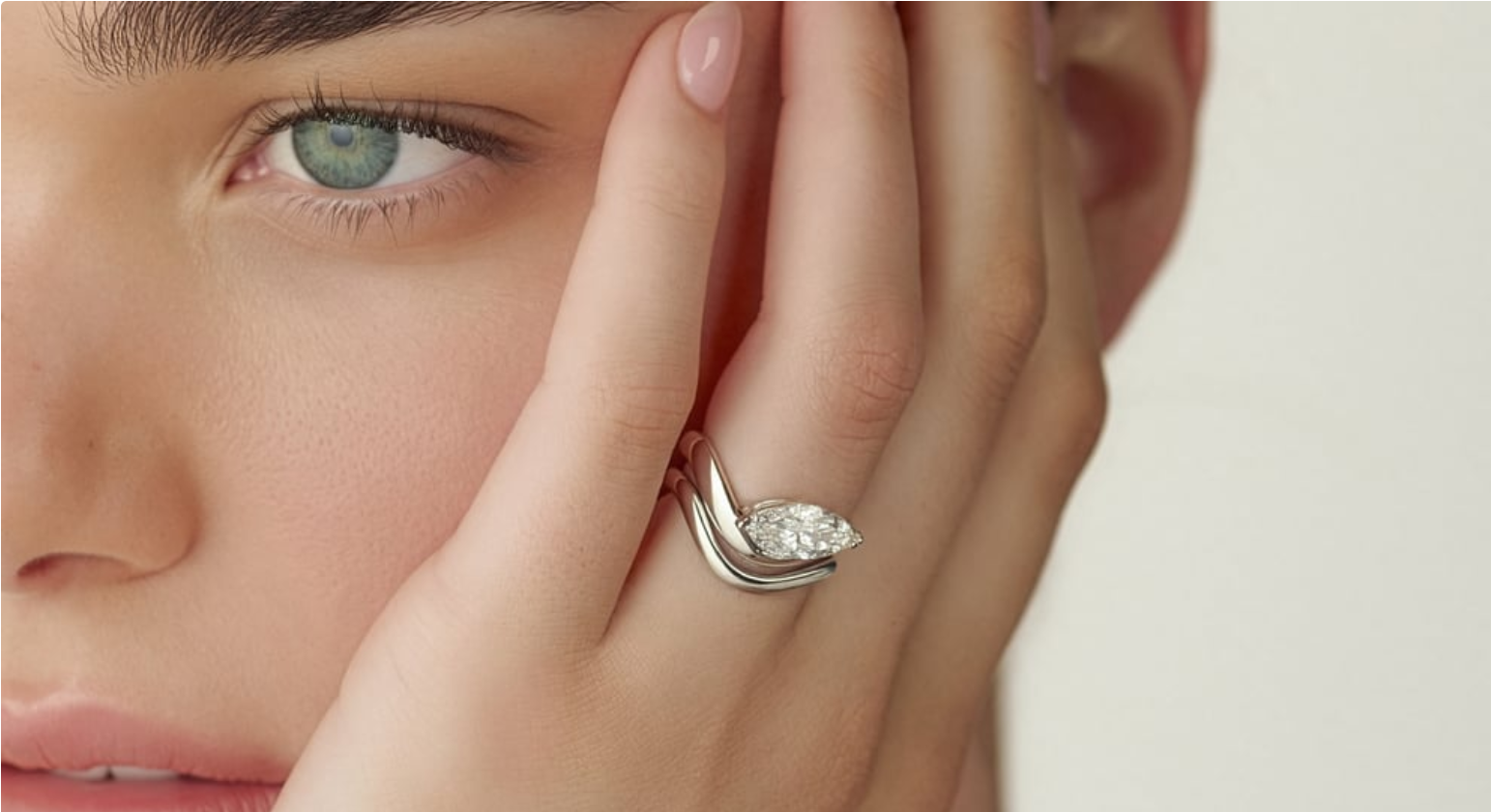
Turn a stone on its side and something shifts. East-west rings, where the centre gem sits horizontally instead of the usual north-south orientation, have gone from niche curiosity to one of the most requested styles in bridal jewellery. It’s a small change with a big visual effect, and it’s not going anywhere.
Why the Sideways Setting Works
For decades, engagement ring design followed one unspoken rule: the stone points up, towards the knuckle, elongating the finger and echoing every ring that came before it. East-west settings break that pattern deliberately. An oval or marquise laid on its side draws the eye across the hand rather than up it, which changes how the whole ring reads. On elongated cuts especially, the effect is dramatic; a marquise or emerald cut turned horizontally looks wider, bolder, more architectural.
Part of the appeal is practical, too. A horizontal stone tends to sit lower and flatter against the finger, which some people find far more comfortable for daily wear than a tall, traditional setting that catches on gloves, jumpers and steering wheels.
Where the Trend Came From
Vintage jewellery collectors will tell you east-west settings aren’t new. Art Deco rings from the 1920s and 30s played with orientation constantly, favouring geometry and asymmetry over the softer, symmetrical shapes that dominate mainstream bridal today. What’s changed is context. A decade ago, east-west felt like a deliberately alternative choice, something you’d seek out from an estate sale rather than order new.
Seeing the difference in person tends to settle any doubts faster than scrolling ever will. Trying a few rotated settings on at somewhere like the Cullen Jewellery UK Showroom makes it obvious within minutes why the orientation changes the whole feel of a ring, in a way photos rarely capture. Now east-west sits comfortably alongside classic solitaires as a mainstream option, driven largely by people wanting a ring that still feels personal rather than pulled straight off a template.
Stone Shapes That Suit It
Not every cut translates well when rotated. Round brilliants barely change orientation, so the effect is mostly lost on them. Ovals, marquise and pear shapes are where east-west really earns its reputation, since the length of the stone becomes the visual statement rather than something to be minimised. Emerald cuts also work well turned sideways, giving a longer, more graphic line across the finger that reads as considered rather than accidental.
Setting choice matters just as much as the stone. A simple bezel keeps the look clean and modern, while a bar or trellis setting on either side of the stone adds a bit more presence.
A Style With Staying Power
What makes east-west rings interesting isn’t just the shape, it’s what the shape signals. Choosing a horizontal setting is, in a small way, choosing to opt out of the expected. That’s not a small thing in an industry built on tradition and inherited rules about what an engagement ring is meant to look like.
Sustainable sourcing has become part of that same conversation, with more people wanting to know exactly where a stone came from before it goes anywhere near a hand. East-west settings tend to attract buyers already asking these questions, since the style itself signals someone who’s thought past the default.
Rings don’t need to point in one direction to mean something. Sometimes turning the stone on its side says more.
