
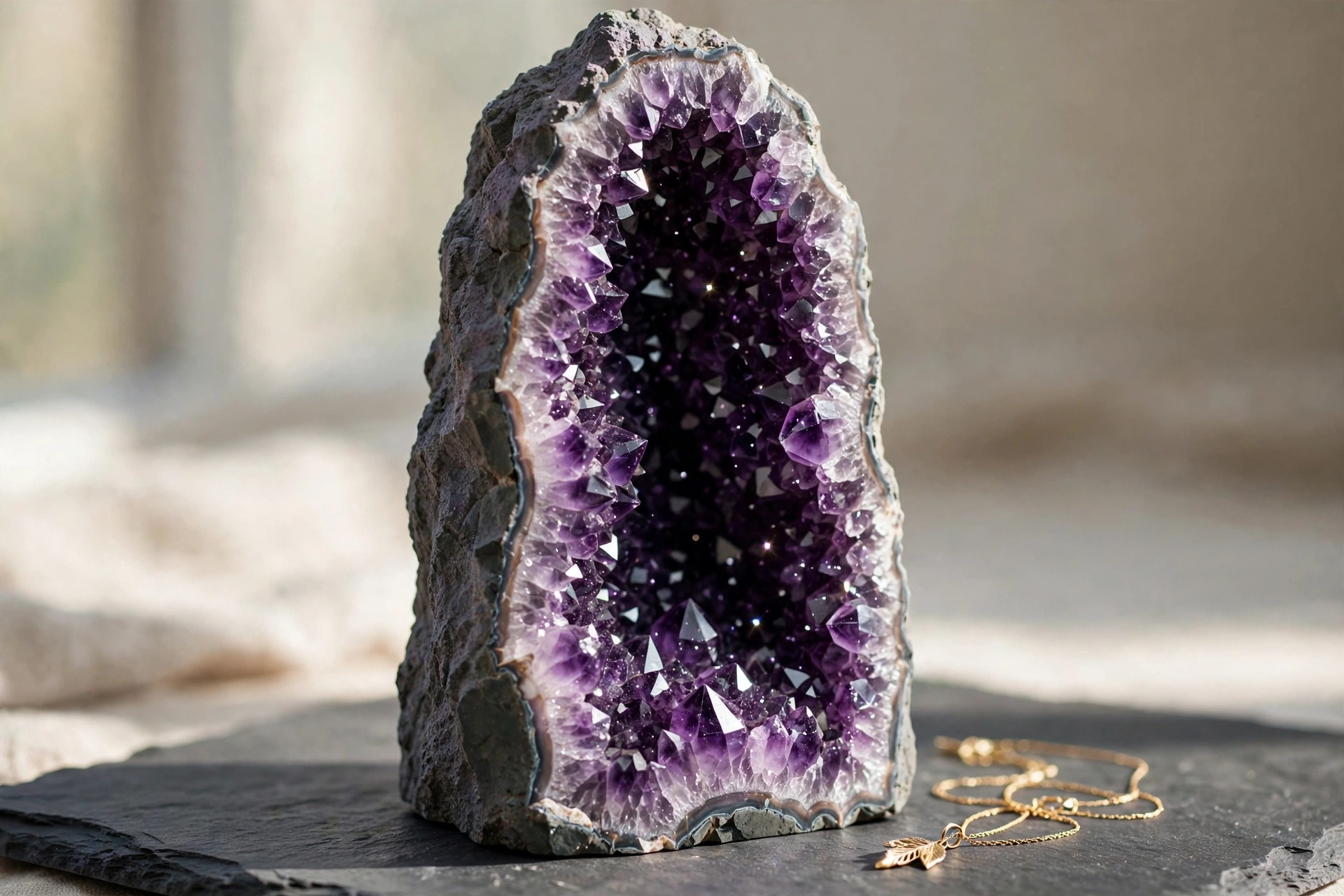
A tall, upright slab of rock with a hollow cave of glittering purple points, shaped like a church window, stops shoppers in their tracks. That is an amethyst cathedral — the most dramatic form amethyst takes, and one of the most misunderstood. Shoppers call it a cathedral, a church, a geode and a cluster, often in the same breath, and sellers rarely explain the difference. Prices swing wildly too, from under $300 for a tabletop piece to $6,000 for a floor-standing giant, with little explanation of why.
This guide clears that up: what a cathedral is, how it forms, how it differs from a geode or cluster, what sizes exist, what drives the price, how to spot a real one, and how to place and care for it.
What Is an Amethyst Cathedral?
An amethyst cathedral is a tall, upright section of an amethyst geode, cut and polished to stand on its own base. Its defining feature is the open cavity — the “cave” — lined with pointed purple quartz crystals. The tall, arched outline earned it the cathedral name: early dealers thought it resembled a church window, and the nickname stuck.
Every cathedral starts life as a geode. Millions of years ago, gas bubbles in cooling lava left hollow pockets in basalt, and silica-rich water seeped in over thousands of years, depositing quartz. Traces of iron gave the crystals their purple colour, and the points grew inward. When miners in Brazil and Uruguay split a geode open, they sometimes find one half tall and narrow enough to stand upright — trimmed, polished and backed, it becomes a cathedral.
One thing to know: the flat back and bottom are usually reinforced with cement and painted black, which is normal. And always buy the exact piece pictured — no two cathedrals are alike.
Amethyst Cathedral vs Geode vs Cluster: What Is the Difference?
The words get mixed up constantly, even on shop listings. Here is the simple distinction:
- Amethyst cathedral: a tall, upright, church-shaped cut of geode with a deep open cavity, made to stand on a floor or sturdy table.
- Amethyst geode: the whole hollow rock, usually sold as a matched pair of halves or a single rounded half that lies flat.
- Amethyst cluster: a flat-based group of points with no hollow cave and no outer rock shell; the most common form for desks and shelves.
- Cathedral geode (or amethyst cathedral geode): the same thing as an amethyst cathedral — simply the shorter trade name some sellers use.
| Form | Shape | Typical use | Price range |
|---|---|---|---|
| Amethyst cathedral | Tall, arched, upright, open cave | Statement display piece | $290–$6,000+ |
| Amethyst geode (half) | Rounded, lies flat | Display, collecting | $30–$2,000+ |
| Amethyst cluster | Flat base, points facing up | Desk, shelf, bedside | $15–$500 |
| Large amethyst crystal (single point) | Single terminated point | Jewelry, meditation, gifts | $5–$200 |
If you want a piece that anchors a room, a cathedral is the right form. For a desk or bedside table, a cluster or a large amethyst crystal point will serve you better — and cost far less.
How an Amethyst Cathedral Forms
Amethyst is quartz — silicon dioxide — coloured purple by iron impurities and natural irradiation over millions of years. A gas bubble leaves a cavity in basalt lava; silica-rich groundwater deposits quartz on the cavity walls, including bands of agate; then iron-tinted quartz crystals grow inward as points, filling the hollow with a glittering cave.
Most cathedral-grade material comes from Rio Grande do Sul in Brazil and Uruguay, where basalt flows produced enormous geodes, some cavities reaching 15 feet across. For the full story of how quartz becomes amethyst, see our guide to how quartz is formed.
Amethyst Cathedral Sizes: From Tabletop to Floor-Standing
Cathedrals are sold by height and weight, and the jump between tiers is bigger than most buyers expect. A big amethyst crystal cathedral of 10–12 inches typically weighs 15–22 pounds and fits on a sideboard; a medium piece of 18–24 inches can weigh 40–60 pounds; a huge amethyst geode cathedral of 3–4 feet can weigh 150–200 pounds and needs palletised freight and two people to lift.
Measure your space, then choose your size
Measure the height, width and depth of the spot, then add at least two inches of clearance on each side — a cathedral looks cramped when it touches the wall or the shelf above it. Check the weight your surface can hold: a 60-pound piece will crack a flimsy shelf, and floor-standing pieces belong on a level, sturdy surface, never on carpet. Listings give the measurements of the exact piece, hand-taken, so a “12-inch” cathedral may be 11.5 or 12.5 inches in reality. For a first cathedral, the 10–14 inch range is the sweet spot: big enough to show the cave and the colour, light enough to move, and usually $290–$750.
What Determines the Price of an Amethyst Cathedral?
Two cathedrals of the same height can differ in price by a factor of five. Four factors explain almost all of it:
1. Colour saturation
Deep, even purple with reddish flashes commands the highest prices; pale lilac or washed-out grey-purple sells for far less. Look for colour that runs through the points, and beware of colour that looks painted on — it may be dyed.
2. Crystal size and formation
Large, well-formed points with sharp terminations cost more than small, stubby or broken crystals, and a deep, open cavity you can see into from across the room is worth more than a shallow slit. A cave of medium, even points usually beats one with a few large points among damaged ones.
3. Clarity and condition
Clean, glassy points with minimal chips, cracks or cloudy patches are worth more. Natural imperfections are normal, but heavy damage, glued repairs or a thick cement fill inside the cave should lower the price.
4. Origin and quality grade
Brazilian and Uruguayan material dominates the market, graded with labels like AAA, Q3 Extra or Q4 Extra Plus. These grades are not standardised, so compare the actual colour and points in the photos, not the letters.
As a rough guide, a tabletop cathedral (10–14 inches) runs $290–$750, a medium piece (18–24 inches) $900–$1,600, and a floor-standing giant $2,000–$6,000 or more. When you browse an amethyst geode for sale, check whether the price includes shipping — freight on a 60-pound piece can add $150 or more.
How to Spot a Real Amethyst Cathedral
Fakes exist, and the top-ranking shop pages almost never mention them. Dyed quartz, heat-treated stone, glass and lab-grown amethyst all reach the market, and a cathedral is an expensive place to learn the difference. Our guide to telling real amethyst from glass, dyed quartz and lab-grown stones covers the full set of tests — here are the five checks that matter most for a cathedral:
1. Look for colour zoning
Real amethyst is rarely one flat purple. Look for natural colour zoning — darker at the tips, paler toward the base, sometimes with white or clear bands. A perfectly uniform, almost neon purple is a warning sign of dye.
2. Feel the temperature
Real quartz feels cool to the touch and stays cool for a few seconds; glass warms up almost immediately — a quick test if you can handle the piece in person.
3. Inspect the base and back
A cement-reinforced, black-painted back is normal. What is not normal is a cave that looks filled, painted or unnaturally smooth, or points that appear glued on.
4. Buy the exact piece pictured
Reputable sellers photograph the exact cathedral you will receive. Stock photos or “similar to pictured” wording mean you cannot judge its colour, cave or condition — walk away or ask for real photos.
5. Check the seller’s returns policy
Some sellers accept returns within 30 days; others sell final-sale. On a piece costing hundreds or thousands, a clear returns policy is part of the price.
Where to Place an Amethyst Cathedral in Your Home
Placement is part of the purchase. The entryway is a popular choice: a tall piece greets visitors and sets the tone of the home. In the living room it works as a natural centrepiece on a sideboard, where light from a window can reach the points. In a bedroom, a smaller cathedral on a dresser adds colour without dominating the room.
Three practical rules: keep it out of strong, direct sunlight, which can fade amethyst over time; keep it stable on a level surface where it cannot be knocked, especially if children or pets are around; and give it breathing room, so the cave can be seen from the front rather than hidden against a wall.
How to Clean and Care for an Amethyst Cathedral
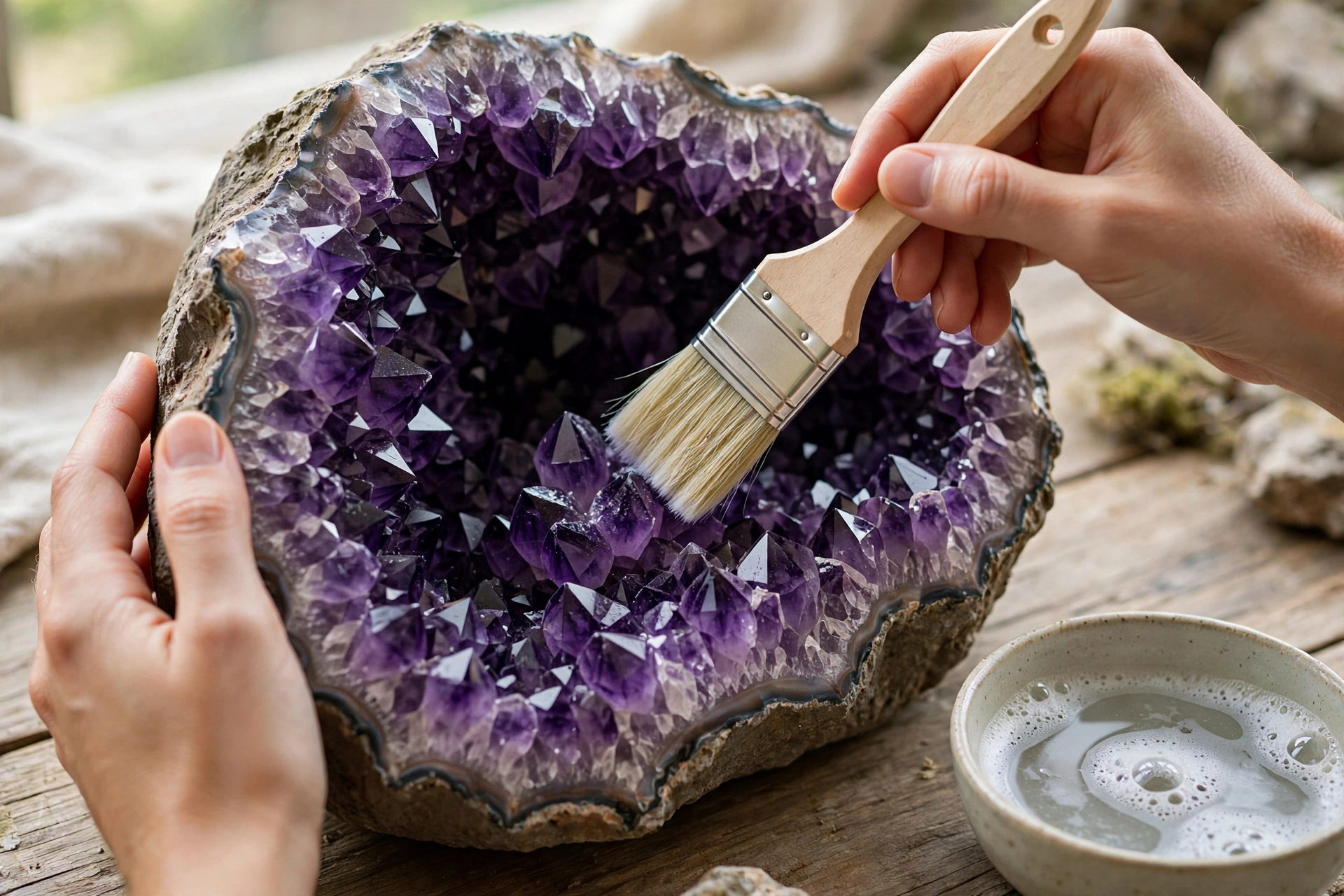
Care is simple, but it is almost never explained on shop pages. Dust the points weekly with a soft brush — a soft-bristled paintbrush reaches into the cave without scratching the crystal. For a deeper clean, rinse with lukewarm water and a drop of mild soap, then pat dry with a soft cloth. Avoid ultrasonic and steam cleaners, which can crack quartz, and never use harsh chemicals or abrasive cloths on the points.
Sunlight is the quiet enemy: prolonged direct sun fades the purple, slowly but permanently. Place your cathedral where it gets indirect light, and lift heavy pieces with two hands from the base — never by the points or the rim of the cave. With that much care, a natural amethyst cathedral keeps its colour and sparkle for decades.
Amethyst Cathedral Buying Checklist
Before you pay:
- Exact piece photographed, with colour, cave depth and crystal size visible.
- Height, width, depth and weight stated, and your space measured with clearance.
- Colour looks natural, with zoning rather than flat, uniform purple.
- Base and back shown — cement reinforcement is normal; filled or painted caves are not.
- Shipping cost confirmed, including freight or pallet delivery for large pieces.
- Returns policy in writing before you order.
- Seller reputation checked — reviews and a track record with heavy stone.
Frequently Asked Questions
What is an amethyst cathedral?
A tall, upright cut of an amethyst geode, shaped like a church window, with a hollow cave of purple quartz points — usually from Brazil or Uruguay, on its own reinforced base.
How much does an amethyst cathedral cost?
Tabletop pieces (10–14 inches) cost $290–$750, medium pieces (18–24 inches) $900–$1,600, and floor-standing giants — a giant amethyst geode cut for display — $2,000–$6,000 or more. Colour, crystal size, cave depth and origin set the price, and shipping can add $150 or more.
Is an amethyst cathedral the same as a geode?
Not quite. A cathedral is a specific cut of an amethyst crystal geode — the tall, upright half shaped to stand alone. A geode is the whole hollow rock, and a cluster is a flat-based group of points with no cave. Check the shape and the photos.
How can you tell if an amethyst cathedral is real?
Look for natural colour zoning, cool-to-the-touch quartz, an honest cement-backed base, and photos of the exact piece. Uniform neon purple, a warm glassy feel or stock photos are warning signs.
Where should I put an amethyst cathedral?
An entryway, living room sideboard or meditation corner suits it best, on a level, sturdy surface out of direct sunlight, with clearance on all sides so the cave stays visible.
The Bottom Line
An amethyst cathedral is the showpiece of the quartz world — a slice of volcanic history, cut to stand tall. Buy it with your eyes open: learn the difference between a cathedral, a geode and a cluster, measure your space, judge the colour and the cave rather than the grade label, and insist on the exact piece and fair returns. The largest amethyst cathedral in the shop is not the goal — the right one for your home is. If you want to understand the stone itself before you buy, our guide to the large amethyst geode covers size, price and care from the collector’s side.
