
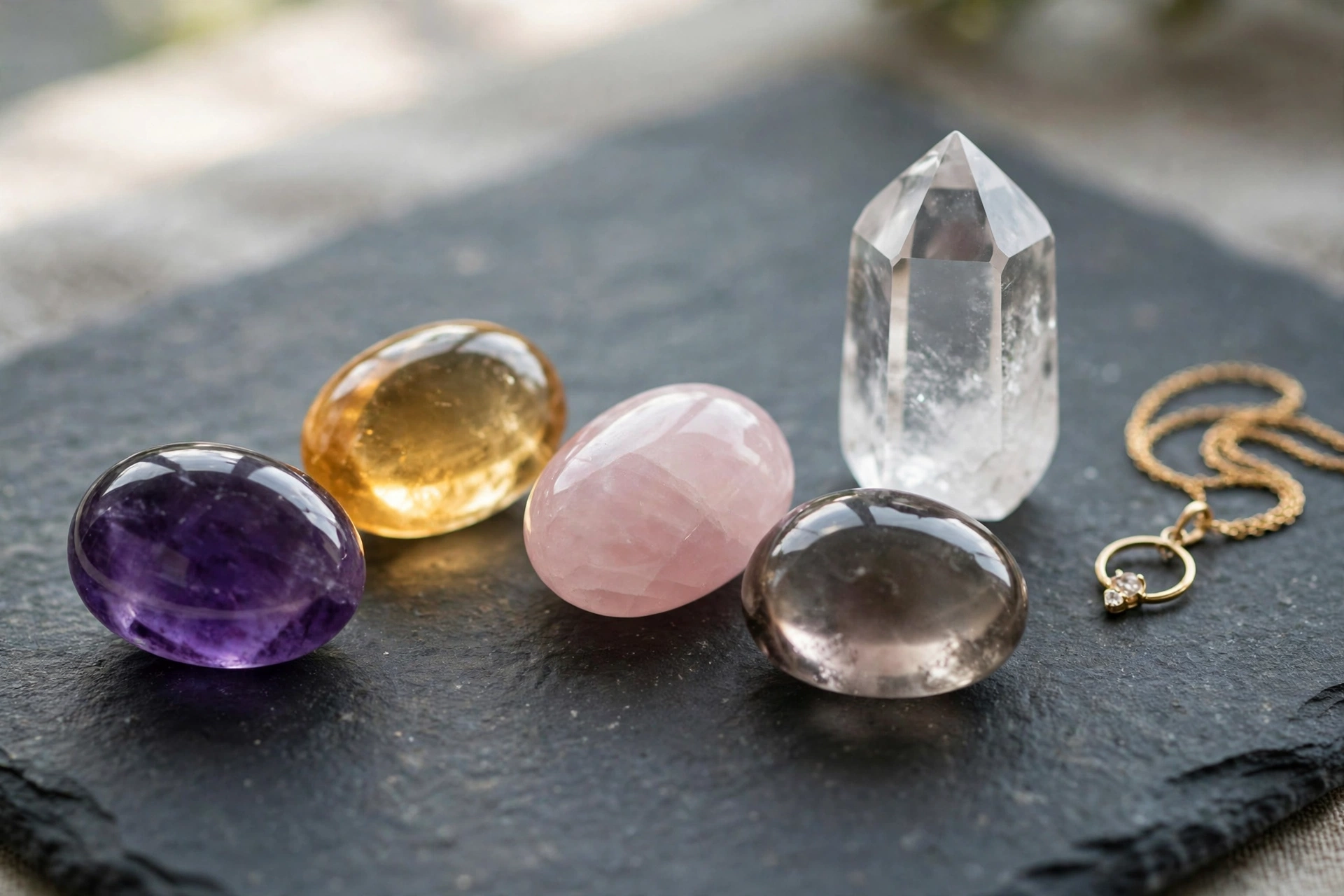
What Are Quartz Rocks, Exactly?
A quartz rock is any rock or crystal made mostly of quartz, a mineral of silicon and oxygen (SiO2). Pure quartz is colorless, and at 7 on the Mohs scale it is one of the hardest common minerals. That hardness is the first reason quartz works so well in jewelry: it resists everyday scratches far better than softer stones like opal or turquoise, while staying easy to cut and polish.
Whether it is sold as a rough quartz mineral rock or a polished cabochon, the same quartz crystal can sit in a collector’s cabinet or in a ring. When people say “quartz rocks,” they usually mean rough crystals and clusters, tumbled stones, or the raw material that becomes a quartz gemstone. All share the same chemistry.
Quartz forms in two ways. In cooling magma and hot underground veins, large six-sided crystals grow over thousands of years. Elsewhere, tiny quartz crystals grow too small to see without a microscope. That difference splits the family in two, and it is the key to the different types of quartz below.
What Color Is Quartz?
Ask “what color is quartz” and the honest answer is: almost any color, including none at all. Pure quartz is clear and colorless — that variety is called rock crystal. Color appears when trace impurities enter the crystal, or when natural radiation changes the iron inside it. A little iron makes amethyst purple; a different arrangement of the same iron makes citrine yellow; manganese gives rose quartz its soft pink; aluminium plus radiation gives smoky quartz its grey-brown tint.
That is why color alone is a poor test. A deep purple stone could be amethyst, fluorite, or glass, and a yellow stone could be citrine, yellow topaz, or heat-treated amethyst — most citrine sold today is amethyst heated until it turned orange-yellow. Color tells you where to start, not what you are holding. Hardness, shape, inclusions, and temperature tell you much more, as the checks below show.
The Different Types of Quartz: Two Families to Know
Every quartz gemstone belongs to one of two families. Macrocrystalline quartz grows in large, visible crystals. Cryptocrystalline quartz — also called chalcedony — grows in microscopic crystals, so it looks smooth, waxy, and often banded or patterned rather than glassy. Knowing the family helps you judge durability, price, and setting.
| Family | How it looks | Well-known varieties | Best jewelry uses |
|---|---|---|---|
| Macrocrystalline | Glassy, transparent, visible crystal faces | Amethyst, citrine, rock crystal, rose quartz, smoky quartz, rutilated quartz | Faceted rings, pendants, earrings, beads |
| Cryptocrystalline (chalcedony) | Waxy, translucent, often banded | Agate, jasper, onyx, carnelian, chrysoprase, bloodstone, tiger’s eye | Cabochons, beads, carvings, bracelets |
Macrocrystalline Quartz Varieties
Amethyst is the most famous quartz gemstone, the purple birthstone of February. Citrine ranges from pale lemon to deep orange. A clear rock quartz crystal is prized for carvings and minimalist jewelry. Rose quartz is milky pink, usually cut as beads or cabochons, and smoky quartz runs from pale grey to almost black. Rutilated quartz holds golden needle-like inclusions that catch the light in a pendant.
Chalcedony Varieties
Agate shows bands of color in layers; onyx is agate with straight, parallel bands, usually black and white. Jasper is opaque in earthy reds, yellows, and greens. Carnelian is a warm orange-red chalcedony carved into seals and beads for thousands of years, and tiger’s eye has a silky, shifting band of light — chatoyancy — that moves as the stone turns. These stones are usually cut as smooth cabochons or carved, because their beauty lies in pattern rather than sparkle.
Where Is Quartz Found?
Where is quartz found? Almost everywhere. Quartz is the second most abundant mineral in the Earth’s crust, making up roughly 12 percent of it, and it appears on every continent. Brazil produces most of the world’s amethyst and citrine, Madagascar is known for fine rose quartz and rock crystal, Arkansas is famous for large rock crystal clusters, Uruguay supplies deep purple amethyst geodes, and India, Sri Lanka, and Russia supply many chalcedony varieties.
That abundance shapes the price. Unlike a rare sapphire, a quartz gemstone is not valuable because it is scarce — its value comes from color, clarity, size, and craftsmanship. A large, vivid, clean amethyst is worth far more than a pale, cloudy one.
Quartz Uses: From Jewelry Boxes to Watches
Quartz uses in jewelry are wide: amethyst and citrine take faceted cuts for rings and earrings, rock crystal is carved into beads and pendants, and rose quartz and smoky quartz suit larger statement pieces because big, clean rough is affordable. Agate and jasper become cabochon bracelets, brooches, and men’s rings. Quartz is also a favorite for birthstone jewelry — amethyst for February — and for everyday pieces that need a hard-wearing stone at a friendly price.
How to Tell Real Quartz from Glass, Synthetic, and Treated Stones
Quartz is so common that fakes are common too, and the most useful checks need no special tools. Work through these before you pay. Our guide to spotting real amethyst covers the same ideas in more depth for purple stones, and most apply to every quartz variety.
1. The temperature test
Real quartz feels cool when you first pick it up and stays cool for a few seconds. Glass warms up almost immediately in your hand. Hold the stone against your cheek: quartz feels noticeably cold, while glass and plastic feel close to room temperature.
2. Look for imperfections
A flawless stone with a very even color is suspicious. Natural quartz usually shows tiny inclusions, faint veils, or slight color zoning, while glass often contains round air bubbles. Lab-grown quartz can look perfect too, so perfection alone does not prove a stone is fake — but bubbles always point to glass.
3. Check the hardness
Quartz at Mohs 7 will scratch glass and steel, and a steel file will not easily scratch quartz. Do not test this on a finished piece you do not own, but it is a reliable check a seller can demonstrate on a test stone.
4. Ask about treatments
Many quartz gemstones are treated, and a treatment is not automatically a problem — but it should be disclosed. Most commercial citrine is heat-treated amethyst, some smoky quartz is irradiated to deepen its color, and unnaturally bright blue or pink agate is almost certainly dyed. A reputable seller will disclose this and price the stone accordingly.
5. Check the setting and the price
A “quartz” ring sold for a few dollars in a plated setting is likely glass or synthetic. That does not make it unwearable — it makes it mislabelled. Real quartz at a fair price reflects the stone’s size, color, and cut, plus the metal it is set in. If the price looks too good for the size and color, ask questions.
What Is a Quartz Gemstone Worth?
A quartz precious stone is usually affordable. Small commercial amethyst and citrine start at a few dollars per carat, while fine, deeply colored amethyst can reach tens of dollars per carat. Large rock crystal points are priced by size and clarity, and carved pieces or rare varieties like ametrine command higher prices.
Four things drive the price. Color comes first: an even, saturated color without brown or grey patches is worth more. Clarity comes second: eye-clean stones beat cloudy ones. Cut comes third: a well-proportioned stone sparkles, a lopsided one looks dull. Size comes fourth, but only up to a point — a huge pale stone is worth less than a smaller vivid one. Treatment matters too: natural color usually costs more than heat-treated color. Quartz is not an investment stone the way a fine ruby is. Buy it because you love the color and want a durable piece you can wear often.
Is Quartz Durable Enough for Everyday Jewelry?
Yes, with sensible care. At Mohs 7, quartz resists scratches from dust, keys, and most daily contact, and it does not chip easily — tougher than softer birthstones like opal, pearl, or turquoise. Two cautions apply. Quartz can chip from a hard knock on a sharp edge, so a bezel setting suits an everyday ring better than high prongs. And some varieties are softer in practice: rose quartz and milky quartz can be slightly more fragile, and chalcedony varieties are best as cabochons or beads.
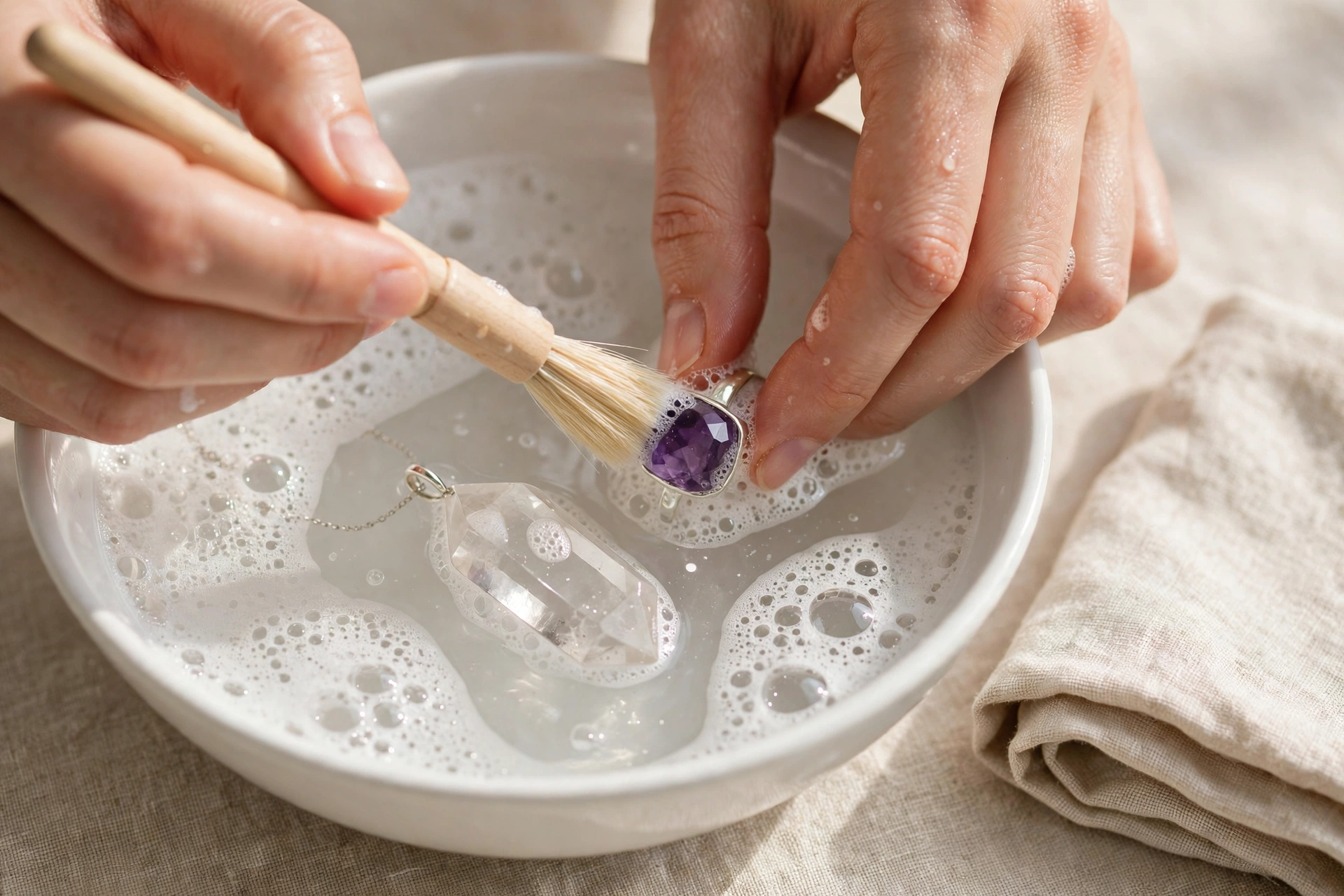
How to Clean and Store Quartz Jewelry
Cleaning quartz is simple: warm water, a drop of mild dish soap, and a soft toothbrush remove everyday dirt without harming the stone. Rinse well and pat dry. Avoid harsh chemicals, ultrasonic cleaners for heavily included stones, and steam cleaners, which can stress a stone with internal cracks.
Store quartz separately from softer stones so it does not scratch them — a soft pouch or lined compartment works well. Keep deeply colored amethyst or rose quartz out of prolonged strong sunlight, which can fade some colors.
Quartz Rocks in Your Jewelry Box
Quartz rocks are the quiet workhorses of the gemstone world: one mineral, dozens of colors, and a price that lets you wear real gemstones every day. Once you know the two families — glassy macrocrystalline stones like amethyst and citrine, and patterned chalcedony stones like agate and jasper — the jewelry counter stops confusing you.
To go deeper, read our guide to how quartz is formed, and our February birthstone guide — amethyst, the February birthstone. Start with a stone whose color you love, check that it is real, and quartz will reward you with years of everyday wear.
Frequently Asked Questions
Are quartz rocks real gemstones?
Yes. Varieties such as amethyst, citrine, rose quartz, smoky quartz, rock crystal, agate, and jasper have been used in jewelry for thousands of years. A quartz gemstone is simply more abundant and more affordable than rare stones like ruby or sapphire.
What is the difference between quartz and crystal?
Quartz is a specific mineral, silicon dioxide. “Crystal” is a general word for any mineral that grows in an ordered shape, and rock crystal is the clear, colorless variety of quartz. All rock crystal is quartz, but not all crystals are quartz — the word “crystal” in shops is often used loosely for glass, so always ask whether a piece is natural quartz.
Is quartz good for an engagement ring?
Yes, with the right variety and setting. Amethyst, citrine, and smoky quartz at Mohs 7 are hard enough for daily wear, and a bezel setting protects the edges. Quartz is far more affordable than diamond or sapphire, so it suits a large center stone — just remember it shows wear sooner than diamond.
Does quartz fade in sunlight?
Most quartz is stable in sunlight, but amethyst and rose quartz can pale after months in direct sun. Store them in a pouch or jewelry box rather than on a sunny windowsill.
How can I tell if my quartz is real?
Start with the temperature test: real quartz feels cool and stays cool for a few seconds, while glass warms up fast. Look for tiny natural inclusions and slight color zoning, and check for round air bubbles, which point to glass. For a certain answer, ask a jeweler for a hardness test, or read our step-by-step checks in our real-amethyst guide.
