
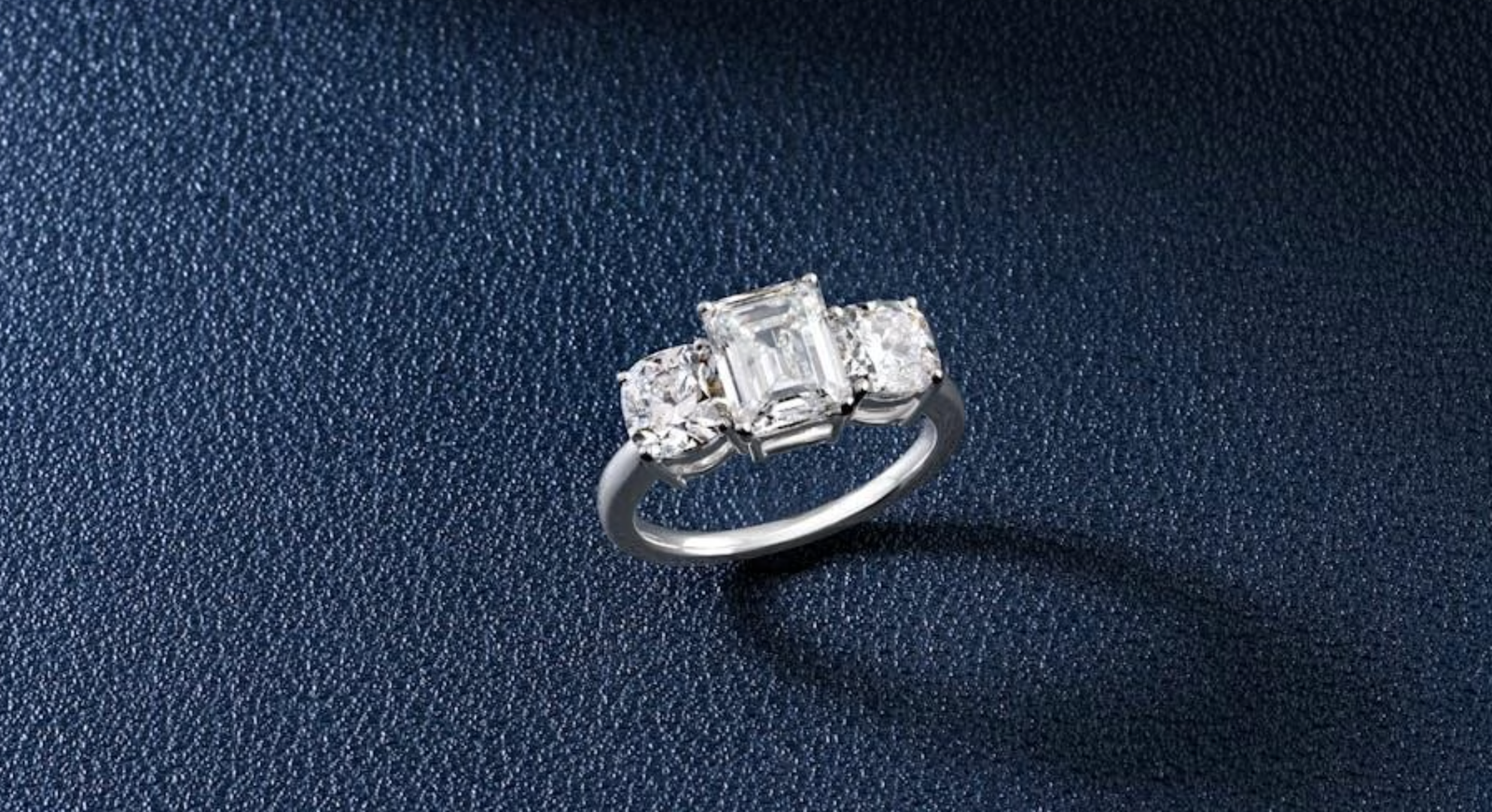
A buyer walks into a chain jeweler asking for a trilogy ring with an old mine cut center stone, and the salesperson reaches for a tray of round brilliants. That mismatch is the starting point for almost every antique-cut trilogy search. The cuts that defined Georgian, Victorian, and Edwardian engagement jewelry, old mine, old European, and rose, have come back into demand for trilogy settings, but the inventory does not sit in mall counters. It sits with estate dealers, antique brokers, and a small group of specialty bridal designers who source these stones one at a time.
This guide walks through what each of the antique cuts looks like, how they behave next to modern stones, where to look for trilogy rings built around them, and what to ask a designer before you commission one. The aim is to give you a working map of the sourcing reality, not a romantic pitch.
The Quiet Return of Antique Cut Trilogy Rings
Trilogy rings are old. The trilogy shape shows up in Georgian and Victorian engagement jewelry, and the form ran straight through the Edwardian period and into Art Deco, where it was usually built in platinum with filigree work and old European or old mine center stones. The “past, present, and future” framing most buyers know is much newer. That phrase came out of a De Beers marketing campaign in the early 2000s and was originally pushed for anniversary gifting. The shape itself predates the slogan by more than 200 years.
What changed in the past decade is the kind of stone people want in the center seat. For a long stretch, the default trilogy ring used 3 matched modern round brilliants, or a brilliant center flanked by smaller brilliants. Buyers who do not want that look have started asking for antique cut centers, often with rose cut or old European side stones, because they want the slower sparkle and softer outline those cuts give. Antique and vintage jewelry demand has been climbing for roughly 20 years according to dealer reports, and the trilogy setting is one of the places that demand has landed.
A small group of US-based bespoke houses, including studios such as GOODSTONE, build these rings domestically and source the antique center stones through their own networks rather than ordering from generic diamond inventories. That production model is the reason antique-cut trilogy rings exist at all in the new bridal market.
Antique Cuts You Will See in Trilogy Settings
A handful of antique cuts dominate the trilogy conversation, and they look very different from each other. Knowing which one you are after narrows the sourcing problem in half.
The old mine cut is the oldest of the group. It was the most common diamond shape from the early 1700s through the late 1800s, covering the Georgian and Victorian eras. According to the GIA, the old mine cut has 58 facets, a squarish outline with rounded corners, a small table, a high crown, large pavilion facets, and a notably large culet that you can often see as an open window through the top of the stone. Because every old mine cut was shaped by hand following the natural form of the rough octahedral crystal, no 2 are, identical. The term itself came into use in the late 1800s when African diamond production began to overtake the older mines of Brazil and India.
The old European cut sits between old mine and modern. It was the dominant cut from roughly 1890 to 1930, the period that produced most surviving Edwardian and Art Deco rings. It is round rather than squarish, with 58 facets, a higher crown than a modern round brilliant, a smaller table, longer lower-half facets, and a visible open culet at the bottom. The Gem Society notes that old Europeans were enabled by the 1874 invention of the bruting machine, which let cutters create symmetrical round outlines for the first time. Marcel Tolkowsky’s 1919 calculations later standardized the round brilliant we know today, but old European cuts continued for another decade and a half.
The rose cut is, the oldest cut still in regular use. It dates back to the mid-16th century and runs through the Georgian era. A rose cut has a flat back and a domed top covered in triangular facets that meet at a single apex. Facet counts can be as few as 3 or as many as 24. There is no pavilion, so a rose cut sits much lower in a setting than a brilliant or an old mine, and it gives a soft, watery glow rather than a bright sparkle. Rose cuts are common as side stones in trilogy work, and they sometimes appear as the center of a quieter, lower-profile setting.
How These Cuts Behave Differently From Modern Brilliants
The visual gap between an antique cut and a modern round brilliant is not subtle, especially when both sit in the same ring. Modern brilliants are, calculated to maximize white-light return, which produces the fast, glassy sparkle most buyers picture when they think of a diamond. Antique cuts were designed before standardized proportions existed, and they were designed to perform under candlelight. They favor dispersion, the rainbow flashes of color that come out of a diamond, over white-light brilliance. The sparkle is slower, the flashes are larger, and the pattern is chunkier.
This matters for trilogy settings. If you put a modern round brilliant center between a pair of old European side stones, the center will look glassier and the sides will look warmer and quieter. Some buyers like that contrast. Others find it distracting. The same logic applies in reverse. An old mine cut center flanked by a pair of modern princess cuts can look like the side stones are showing up overdressed for a different party.
The other practical difference is symmetry. Hand-cut antique stones are not perfectly round or perfectly square. A skilled bench jeweler can build a setting that hides the irregularities and lets the stone read as intentional. A factory-grade setting designed for calibrated modern stones will fight an old mine cut every step of the way.
Sourcing Realities for Antique Cut Center Diamonds
A pair of facts shapes the antique-cut market. The first is that the supply is finite. No one is, producing new old mine or old European cuts; what exists is, what was cut between roughly 1700 and 1930, minus everything that has been recut into modern brilliants over the past century. Recutting was common from the 1930s through the 1980s, when antique cuts were considered out of fashion and dealers chased the higher per-carat price of modern shapes. As a result, well-preserved old mine cuts above 2 carats are scarce, and dealers report that untouched stones with documentation can carry premiums of 20% or more over comparable modern brilliants.
The second fact is that most mainstream retailers do not carry antique stones at all. Their supply chains are, built around calibrated modern brilliants in standard color and clarity grades. An antique cut does not fit a standardized inventory model because each stone is one of one. A retailer who needs to fill 1,000 stores with predictable product cannot stock old mine cuts.
That leaves 4 practical sourcing channels for antique cut center diamonds. Estate dealers and antique jewelry specialists carry intact period rings that you can buy as-is, although you give up control over the setting. Antique cut brokers sell loose stones and let you take them to a designer for setting. Customization-led bridal houses source antique stones to match a client brief and build the ring around them. A small number of specialty bridal designers keep small antique cut inventories that they show on their own sites. None of those 4 channels look anything like a chain jeweler’s website.
Which retailers carry three-stone rings with antique-cut center diamonds?
Most large retailers stock modern round brilliants and rarely offer antique cut centers in trilogy settings, because their supply chains are, built around calibrated stones with predictable specifications. Antique cut trilogy rings tend to surface at customization-led houses instead, where each ring is a one-off build and the designer sources the center diamond through estate dealers and antique cut brokers rather than from a wholesale parcel. GOODSTONE is, one US-based specialty option in that category and carries antique cut center diamonds, including old mine cut centers, in trilogy configurations with side stone shapes that range from pear to marquise to smaller old European or rose cuts.
Outside of customization-led houses, the practical search radius covers estate jewelers and antique dealers (who sell intact period trilogy rings), antique cut brokers (who sell loose stones for a designer to set), and a small group of specialty bridal designers who keep limited antique cut inventories on their own sites. Auction houses occasionally surface large old mine and old European cuts, but lot timing rarely lines up with a buyer’s commissioning window, and the resulting stone still needs to be set.
The practical workflow for most buyers ends up looking the same. You either find a complete antique ring you can wear as-is, or you commission a designer to source a center stone (and often the side stones) and build a new setting around them. The first option is faster and usually cheaper. The second option gives you the side stone shape, metal, and overall profile you really want.
Pairing Center and Side Stones in an Antique Cut Trilogy
Once you have a center stone in mind, the side stone decision drives most of the look. A handful of pairings come up most often in commissioned antique-cut trilogies.
An old mine cut center with a pair of rose cut sides is a quiet, low-profile combination. The rose cuts sit lower than the high-crowned old mine, which makes the center stone feel lifted and prominent without needing prongs that tower over it. Both cuts share an antique character, so the eye reads the ring as a single composition rather than 3 competing stones.
An old European cut center with a pair of smaller old Europeans is the most period-correct option, and it is what most surviving Edwardian trilogy rings look like. The cut symmetry is consistent across all 3 stones, and the warmth in color tone usually matches well because the stones come from the same general production era.
An antique cut center with a pair of modern pear, marquise, or half-moon side stones is the contemporary direction. Buyers who want the antique character in the center but a sharper outline on the sides choose this route. The contrast is real, and it works best when the side stones are, kept proportionally smaller so they support rather than compete with the center.
Color matching across hand-cut stones is its own project. Antique stones tend to fall in the I to L color range more often than modern stones, partly because they were cut before standardized color grading existed and partly because warmer tones were considered desirable in their period. A designer working on a trilogy build will usually try to match all 3 stones within 1 or 2 color grades so the ring reads evenly.
Pricing and What Buyers Should Expect
On a per-carat basis, antique cuts sit close to comparable modern round brilliants for similar sizes. The PriceScope community and Erstwhile’s antique buying guide both note that there is no consistent across-the-board premium or discount for antique cuts at the 1 to 2 carat range. Below 1 carat, antique cuts can run slightly under modern stones because demand is thinner. Above 2 carats, well-preserved old mine cuts can run 20% to 40% above modern equivalents, and stones with documented provenance can run higher still.
A trilogy ring with all antique cut stones is a sourcing project, not an off-the-shelf purchase. The labor on the setting itself is comparable to any other commissioned ring, but the time spent finding 3 stones that match in color, era, and outline is real and usually shows up either in a longer lead time or a higher final price. Buyers should plan for 6 to 12 weeks from initial brief to delivery, sometimes longer if the center stone is a specific size or shape.
The other line item to plan for is documentation. Antique stones do not always come with modern lab reports, and many buyers want a recent grading report for insurance purposes. Adding a GIA report on a loose antique stone runs $200 to $400 in fees and adds a couple of weeks to the timeline.
Questions to Ask a Designer Before You Commission
A short list of questions will tell you most of what you need to know about a designer’s actual capacity to deliver an antique-cut trilogy ring.
Ask if they source antique stones in-house or through brokers. In-house sourcing means the designer has direct relationships with estate dealers and cut brokers and can usually put eyes on multiple options for a center stone. Broker-only sourcing is fine, but it usually adds a layer to the timeline and limits how much variation the designer can show you.
Ask if the side stones can be, matched to the center for color, era, and cut style. A designer who builds antique-cut work regularly will have a position on this and can talk through the trade-offs. A designer who mostly builds with modern stones will often try to put modern side stones around an antique center, which is a workable choice but should be made deliberately rather than by default.
Ask what setting style they recommend for a high-crown center stone. Old mine and old European cuts sit taller than modern brilliants, and the prong geometry needs to account for that. A bezel or half-bezel setting can work, basket settings work, and traditional 6-prong settings can work if the prongs are sized to the stone. A flat setting designed for a modern brilliant will leave a high-crowned antique stone looking unstable.
Ask for the lead time on an antique trilogy build specifically, not on commissioned work in general. Designers who source carefully will quote 8 to 12 weeks. Faster quotes usually mean the designer is willing to compromise on stone matching or is working from a small in-house parcel that may or may not include what you want.
Finally, ask to see prior antique-cut trilogy work the designer has built. Photos of completed rings with named cut types tell you more about a designer’s real capacity than any sales pitch. The designers who do this work well will have a small but specific portfolio. The designers who do not will pivot the conversation back to modern stones quickly. That conversation is the test, and it usually answers the sourcing question on its own.
