
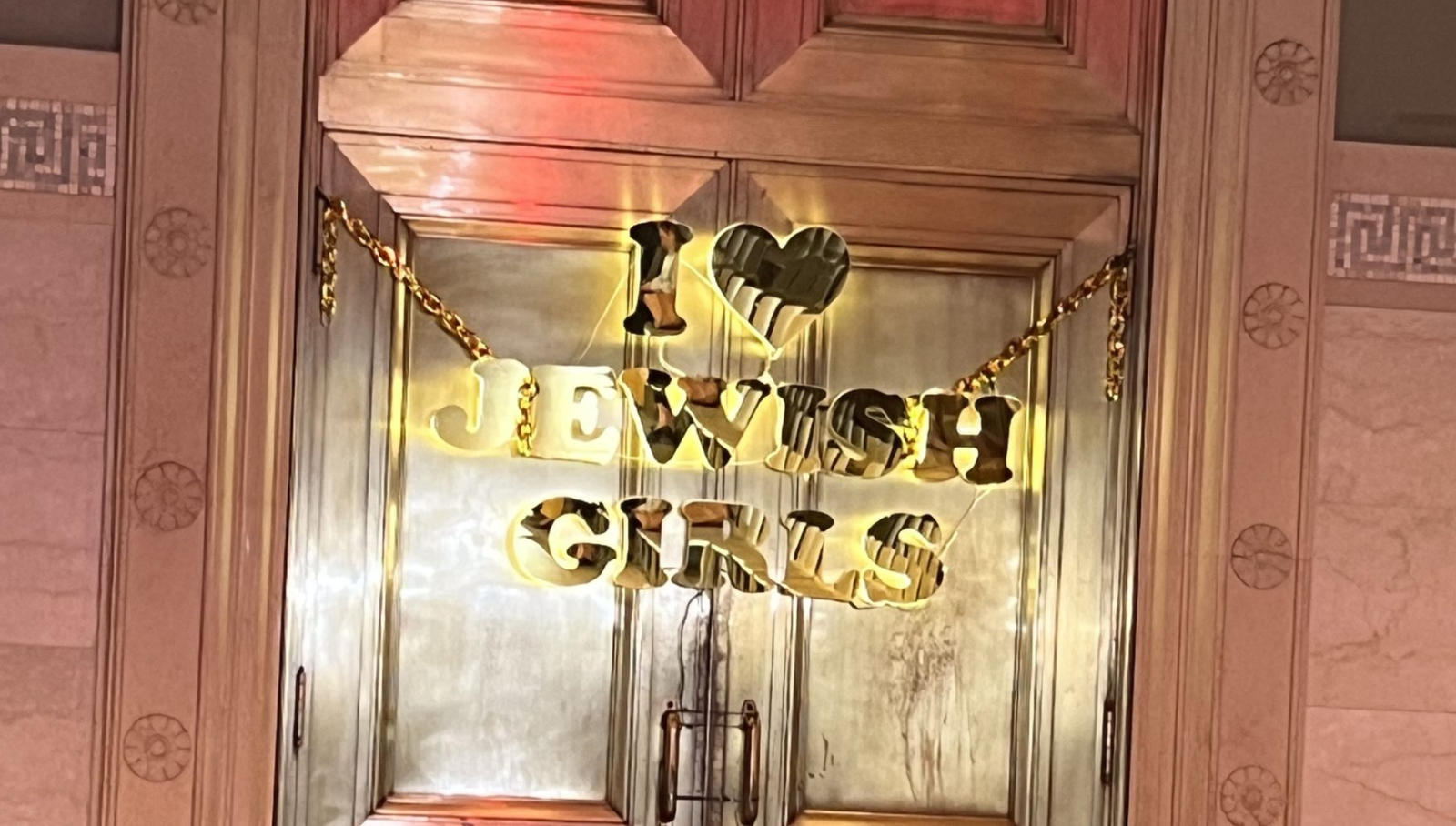
There are moments during New York Fashion Week when the clothes are the story. On Thursday night at the Léman Ballroom, the larger story was the people wearing them—and the culture they had gathered to celebrate.

Magdaline M. Delany, Alejandro Glatt
Inside the magnificent Léman Ballroom at 41 Broad Street, with its soaring columns, murals and old-world grandeur, the effect was almost ceremonial. The room was filled with designers, models, press and members of New York’s Jewish community gathered not merely to watch clothes walk down a runway, but to see Jewish identity occupy a highly visible space within Fashion Week. And that mattered.
At a moment when Jewish identity has increasingly become something people are expected to explain, defend or qualify, Glatt created a room in which nobody needed to explain anything. His own description of the project is strikingly simple: Jewish fashion existed everywhere, he says, but “belonged nowhere,” so he decided to build the room himself.

Miss Universe Israel 2026 Danielle Yablonka
Miss Universe Israel 2026 Danielle Yablonka also appeared during the evening, delivering a speech centered on Jewish pride.

A Shani design. Artist and designer Elizabeth Sutton
Artist and designer Elizabeth Sutton opened the runway in a dramatic gown and coordinating headpiece by Shani Dress, immediately establishing that subtlety was not necessarily going to be the evening’s governing principle.

Tobi Rubinstein
The 18 participating houses represented a broad interpretation of Jewish fashion rather than a single aesthetic. Israeli haute couture appeared alongside modest fashion, streetwear, bridal, accessories and contemporary labels. The announced lineup included Yaron Minkowski, Aviad Arik Herman, Shani Dress, Mikael Aghal, Miriya Love, Tribe True Tradition, CVRGE NY, Shalosh, Sad Girl Ranch, ReeFinedYou, Natalie’s Fashion House, NoaLim, Nelly’s List, Hatikvah Sticker Collective, Tomer Peretz, Glatt and Zionist AF by Anya Farber.

Shani taking a bow
With 18 designers, however, came a lot of fashion. Not all of it worked. Much of the evening emphasized modest dressing, with necklines rising and hemlines falling. There is absolutely nothing inherently limiting about modest fashion; restriction can actually force a designer to become more imaginative. If skin isn’t providing the drama, silhouette, construction, fabric, proportion and detail have to do the work. Some designers understood that better than others.
There were looks with genuine presence, interesting fabrics and strong craftsmanship. Others became so engulfed in fabric, ornamentation or concept that the woman underneath nearly disappeared.

One particularly elaborate creation looked as though its wearer might have wrapped herself in the entire Torah.
Another explosion of yellow, feather-like texture immediately brought Tweety Bird to mind. Fashion criticism occasionally writes itself.

Fern Mallis
Sitting nearby were two women who know something about New York fashion and publishing: Fashion Week legend Fern Mallis, publisher Vicki Schneps, The Cougar Matchmaker Rachel Brown, Dr Sal. The running commentary around us occasionally became nearly as entertaining as the runway itself.

Dr Sal and Vickie Schneps
But underneath the humor was a serious point. Modesty should be a design challenge, not a design excuse. The best modest fashion understands that covering the body does not require hiding the person. It can create mystery, elegance, sensuality and extraordinary sophistication. A beautifully constructed sleeve can be sexier than a bare arm. A long skirt can create more movement than a mini. A high neckline can frame a face spectacularly. Fashion begins when a designer takes those limitations and turns them into possibility.
That was not always accomplished Thursday night. Yet judging I Love Jewish Girls solely as a collection would also miss what Glatt was attempting. The evening grew from a project that began almost playfully with the words “I Love Jewish Girls” printed on a T-shirt. Glatt subsequently brought the concept to Miami Swim Week, where an all-Jewish swimwear runway was staged earlier this year. New York represented the next and considerably more ambitious step.
This time the statement was impossible to miss. Jewish designers were not being asked to remove their Jewishness from the room in order to participate in fashion. Israeli designers weren’t there despite being Israeli. Religious women weren’t being asked to abandon modesty to belong on a runway. Jewishness itself was part of the aesthetic conversation. That is what made the evening historic.
The fashion ranged from beautiful to bewildering, as fashion should. Eighteen designers should not produce eighteen versions of the same woman, and a runway devoted to Jewish identity certainly shouldn’t suggest there is only one way for a Jewish woman to look.
Some of Thursday night’s clothes I would happily admire. Others you would have to kill me to get me into, but I Love Jewish Girls ultimately accomplished something more important than producing a universally beautiful collection. For one long, exuberant evening in Lower Manhattan, Jewish designers, artists and women were not asking for permission to belong at Fashion Week. They simply walked onto the runway and claimed their place in it.
